Lillian Hellman represents one of many mainstream US playwrights who have capitalized (in a good way) on the basic well-made play format Scribe originated nearly 100 years before Hellman's Children's Hour.
My question: what do you see as some of the most significant departures from the well-made play form in this play? Identify them, explain how they're departures from well-made play norms, and persuade us that they're especially significant dramaturgical choices.
On a whole other level--and as an optional Question To Consider: while this play once held a solid place in the American literary canon of Great Plays, some feminist and LGBTQ critics have begun to see this as a problematic play for its attitudes toward same-sex female sexuality. To be sure, one can say the play is harder on those who would rush to judgment about lesbian people. It's also true that Hellman is merely reflecting the majority views of her culture.
At the same time, the "tragic lesbian"--a character who loves other women and tragically dies (usually of suicide)--is a well-worn trope in much 20th and 21st-century literature and theatre. It suggests that lesbian love is essentially some kind of incurable, tragic sickness that dooms the sufferer to isolation and an early grave. See, especially, the 1928 novel The Well of Loneliness. There's even a play that parodies that trope by a troupe called the Five Lesbian Brothers: Brave Smiles: Another Lesbian Tragedy.
The question, then: especially as we are increasingly aware of how homophobic attitudes may be contributing to suicides among LGBTQ people, is The Children's Hour a play that ought to be done today? Why or why not? Can you think of other plays that are technically good but that we probably don't or shouldn't produce today?
See you Wednesday,
JF
Monday, October 21, 2013

Wednesday, October 16, 2013
Prompt Six: Glass of Water
On Wednesday, we talked about how in the well-made play all the dramaturgical parts fit together tightly.
For the most part, this is the case in The Glass of Water--except for two small moments. Two moments of the version of the script you're reading are not in Scribe's original but are instead slight changes by the translator.
Use your own dramaturgical spidey sense. See if you can identify a moment or small element of this script that doesn't seem to fit with the rest of the play. State your answer and persuade readers why the moments you located don't seem to fit.
The point here is for you to guess and defend on your own. No fair looking up "the right answer" in a book/Google/article!
JF
For the most part, this is the case in The Glass of Water--except for two small moments. Two moments of the version of the script you're reading are not in Scribe's original but are instead slight changes by the translator.
Use your own dramaturgical spidey sense. See if you can identify a moment or small element of this script that doesn't seem to fit with the rest of the play. State your answer and persuade readers why the moments you located don't seem to fit.
The point here is for you to guess and defend on your own. No fair looking up "the right answer" in a book/Google/article!
JF
Thursday, September 19, 2013
Prompt Five: 4000 Miles
First off, Dr. Fletcher's late with this prompt, so you have until Sunday night at 9:00 PM to make an initial response posting here. Read the play for Friday's class, but don't stress about posting tonight (Thursday night).
So: this play. On one level, there's nothing so extreme as suicide, murder, or necrophilia here to shock you. It's a quieter piece. On another level, though, this script's dramaturgy is more complicated than is 'Night, Mother or even Judith. For both of those plays, I asked you to come up with a Major Dramatic Question that could work in the plot. That's a complicated assignment for either of those two pieces, but I think it's even more complicated with 4000 Miles. There's no really obvious objective or mission (kill myself? stop her from killing herself? kill him? become a national hero?). Instead the script has a kind of slice-of-life feel to it, as if we're dipping into random moments from an odd period in Leo's and Vera's lives.
Here's the thing, though: slice-of-life scripts are never truly random. The element of choice--why does Amy Herzog put these parts of the story in the plot and not others?--is vital here. Were you to produce this play, you'd need to come up with some kind of pattern, question, or principle to make sense of why this script stages the scenes it does.
I'm tempted, then, to ask you once again to come up with a Major Dramatic Question for this script. You can do that if you feel so moved, but I'd like you to post instead about a motif you notice in this play. What's a repeated line, image, or pattern that you see recurring throughout the play? What keeps happening? Could this motif work as an explanatory pattern for understanding this play? Does the motif recur statically, just repeating the same way? Or does the motif shift slightly as the play progresses? Better--does the effect or significance of the motif change as the play progresses?
Post when you can, but do be ready to discuss this play tomorrow (Friday, 9/20) in class.
Best,
JF
So: this play. On one level, there's nothing so extreme as suicide, murder, or necrophilia here to shock you. It's a quieter piece. On another level, though, this script's dramaturgy is more complicated than is 'Night, Mother or even Judith. For both of those plays, I asked you to come up with a Major Dramatic Question that could work in the plot. That's a complicated assignment for either of those two pieces, but I think it's even more complicated with 4000 Miles. There's no really obvious objective or mission (kill myself? stop her from killing herself? kill him? become a national hero?). Instead the script has a kind of slice-of-life feel to it, as if we're dipping into random moments from an odd period in Leo's and Vera's lives.
Here's the thing, though: slice-of-life scripts are never truly random. The element of choice--why does Amy Herzog put these parts of the story in the plot and not others?--is vital here. Were you to produce this play, you'd need to come up with some kind of pattern, question, or principle to make sense of why this script stages the scenes it does.
I'm tempted, then, to ask you once again to come up with a Major Dramatic Question for this script. You can do that if you feel so moved, but I'd like you to post instead about a motif you notice in this play. What's a repeated line, image, or pattern that you see recurring throughout the play? What keeps happening? Could this motif work as an explanatory pattern for understanding this play? Does the motif recur statically, just repeating the same way? Or does the motif shift slightly as the play progresses? Better--does the effect or significance of the motif change as the play progresses?
Post when you can, but do be ready to discuss this play tomorrow (Friday, 9/20) in class.
Best,
JF
Friday, September 13, 2013
Prompt Four: Judith
As you can tell, Judith is a much different animal than 'Night, Mother.
In case you didn't know, this play is a version of a Bible story, the book of Judith. That book is part of the Christian Apocrypha; that is, it is recognized as scripture by some Christian traditions (such as the Roman Catholic and Eastern Orthodox Churches) and not by others (such as most Protestant denominations). Regardless, the story of Judith has long been part of Judeo-Christian culture. Judith represents something of a trope in Biblical literature: the Israelite heroine who saves her people from certain destruction (see also Esther and Deborah). Various artists have captured key moments of the story, perhaps most famously Caravaggio:
 Fun stuff, no?
It's important to note that elements of this trope often involve the heroine tricking, seducing, or otherwise betraying the enemy, making the image of Judith somewhat complicated. She is both national hero and personal betrayer.
Now, you don't really need an in-depth knowledge of the Biblical Judith to get Judith by Howard Barker. As I hope you realize, Barker is using the Biblical story as a jumping-off-point. He's not writing Sunday School dramas for his local church.
Indeed, I want you to notice how Barker's whole style seems interested in something other than a faithful retelling of an old story. Note, for example, how his dialogue shifts from a kind of poetic high speech to Cockney cursing and back again, almost like these are modern-day people playing at classical figures. The significance of this choice I leave to you to determine, but I do want you to be aware of it as a choice on his part. Barker is in fact renowned as a wordsmith. That is, he uses language very precisely, even indicating moments of (what--emphasis? intensity?) by bold printing the dialogue. (His works, by the way, offer great material for actors who want practice in heightened speech.)
With all this in mind, I'm going to pose the same basic question as I did for 'Night, Mother: what's the Major Dramatic Question of this play? As was the case with Norman's play, I would encourage you to look past the obvious question ("Will Judith kill Holofernes?"). A hint: how is Judith different at the start of the play versus the middle of the play versus the end of the play?
I look forward to your thoughts.
Best,
JF
In case you didn't know, this play is a version of a Bible story, the book of Judith. That book is part of the Christian Apocrypha; that is, it is recognized as scripture by some Christian traditions (such as the Roman Catholic and Eastern Orthodox Churches) and not by others (such as most Protestant denominations). Regardless, the story of Judith has long been part of Judeo-Christian culture. Judith represents something of a trope in Biblical literature: the Israelite heroine who saves her people from certain destruction (see also Esther and Deborah). Various artists have captured key moments of the story, perhaps most famously Caravaggio:
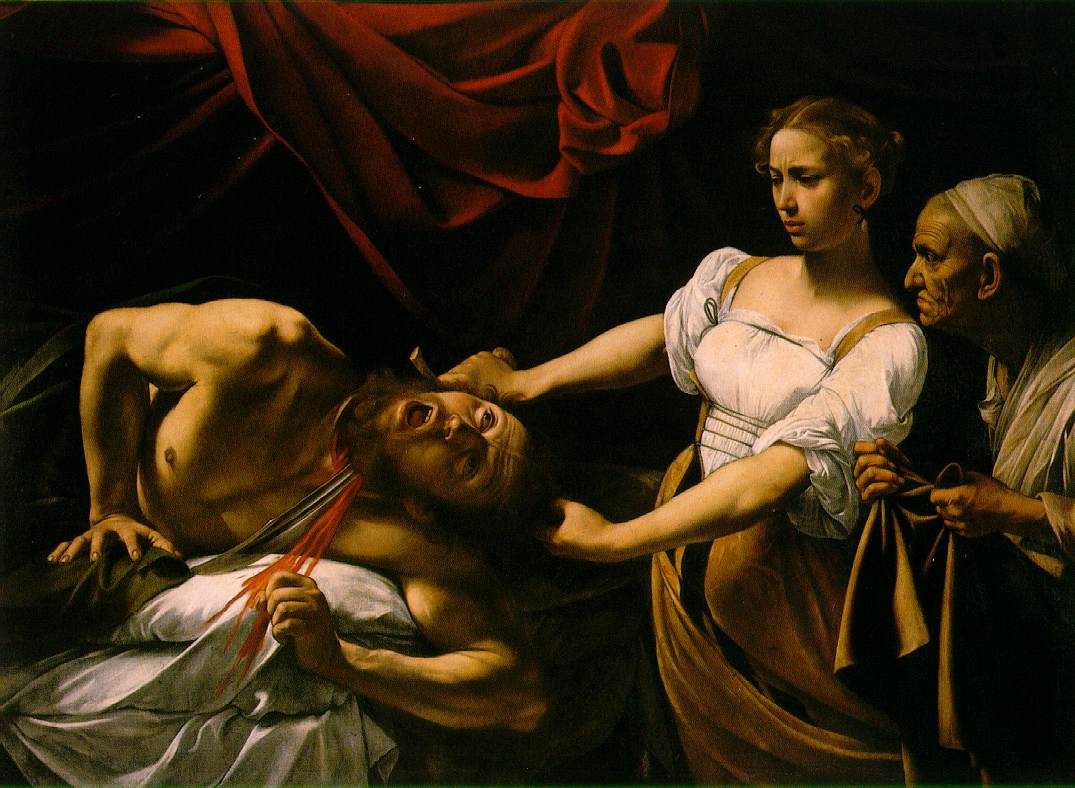
It's important to note that elements of this trope often involve the heroine tricking, seducing, or otherwise betraying the enemy, making the image of Judith somewhat complicated. She is both national hero and personal betrayer.
Now, you don't really need an in-depth knowledge of the Biblical Judith to get Judith by Howard Barker. As I hope you realize, Barker is using the Biblical story as a jumping-off-point. He's not writing Sunday School dramas for his local church.
Indeed, I want you to notice how Barker's whole style seems interested in something other than a faithful retelling of an old story. Note, for example, how his dialogue shifts from a kind of poetic high speech to Cockney cursing and back again, almost like these are modern-day people playing at classical figures. The significance of this choice I leave to you to determine, but I do want you to be aware of it as a choice on his part. Barker is in fact renowned as a wordsmith. That is, he uses language very precisely, even indicating moments of (what--emphasis? intensity?) by bold printing the dialogue. (His works, by the way, offer great material for actors who want practice in heightened speech.)
With all this in mind, I'm going to pose the same basic question as I did for 'Night, Mother: what's the Major Dramatic Question of this play? As was the case with Norman's play, I would encourage you to look past the obvious question ("Will Judith kill Holofernes?"). A hint: how is Judith different at the start of the play versus the middle of the play versus the end of the play?
I look forward to your thoughts.
Best,
JF
Wednesday, September 11, 2013
Prompt Three: 'Night, Mother
Fair warning: this prompt contains SPOILERS for the play.
OK?
Here goes: Suppose you're the dramaturg for a production of 'Night, Mother and the conversation turns to the play's Major Dramatic Question (MDQ). As you'll know from Wednesday's class, the MDQ is a yes/no question (or succeed/fail project) that drives the script. Once the MDQ gets answered, the script ends. Often (but not always) the MDQ is the same as the protagonist's central objective. As we noted, the MDQ is a tool that can help unpack the workings of some scripts; it's not a law that every script has to follow. Some plays benefit from MDQ conversations; some don't.
In our hypothetical production scenario, though, let's imagine that the director is convinced that (1) 'Night, Mother is one of those plays that can benefit from an MDQ conversation; and (2) that the major dramatic question for 'Night, Mother is "Will Jesse kill herself?"
Now, on one level, this question "works." The script ends soon after that question gets answered (i.e., yes, Jessee kills herself). But, over and above being a workable question, I want you to consider whether "Will Jesse kill herself?" is the most productive or interesting major dramatic question. I mean, if the whole goal was for Jesse to kill herself, then I'd expect the script to go something like this:
In other words, there's a whole lot of script here, and only a bit of it really has to do directly with the question of whether or not Jesse will commit suicide. What else is going on? Is there another possible MDQ at work in 'Night, Mother?
For this post, then, I want you to respond (as dramaturg) to this hypothetical director. You can agree with her MDQ, supporting why you think this is the case. Or you can disagree with her by offering a different MDQ, explaining how and why your alternative is superior.
As always, contact Jenny or me if you have questions or concerns.
JF
OK?
Here goes: Suppose you're the dramaturg for a production of 'Night, Mother and the conversation turns to the play's Major Dramatic Question (MDQ). As you'll know from Wednesday's class, the MDQ is a yes/no question (or succeed/fail project) that drives the script. Once the MDQ gets answered, the script ends. Often (but not always) the MDQ is the same as the protagonist's central objective. As we noted, the MDQ is a tool that can help unpack the workings of some scripts; it's not a law that every script has to follow. Some plays benefit from MDQ conversations; some don't.
In our hypothetical production scenario, though, let's imagine that the director is convinced that (1) 'Night, Mother is one of those plays that can benefit from an MDQ conversation; and (2) that the major dramatic question for 'Night, Mother is "Will Jesse kill herself?"
Now, on one level, this question "works." The script ends soon after that question gets answered (i.e., yes, Jessee kills herself). But, over and above being a workable question, I want you to consider whether "Will Jesse kill herself?" is the most productive or interesting major dramatic question. I mean, if the whole goal was for Jesse to kill herself, then I'd expect the script to go something like this:
The lights come up. Jesse goes into a back room while Mama putters around. We hear a shot. Mama jumps, startled. She asks, "What was that?" End of play.
In other words, there's a whole lot of script here, and only a bit of it really has to do directly with the question of whether or not Jesse will commit suicide. What else is going on? Is there another possible MDQ at work in 'Night, Mother?
For this post, then, I want you to respond (as dramaturg) to this hypothetical director. You can agree with her MDQ, supporting why you think this is the case. Or you can disagree with her by offering a different MDQ, explaining how and why your alternative is superior.
As always, contact Jenny or me if you have questions or concerns.
JF
Tuesday, September 3, 2013
Post Prompt 2: Trifles
Greetings, all--
I know about half of you still have to create blog sites, and many of you haven't yet gotten around to posting on Overtones yet. You still have time; the posts aren't due until Tuesday night.
Nevertheless, since we're scheduled to read Trifles for this Friday (9/6), I wanted to get the prompt for that play up as well.
So: for this posting, imagine that someone in the department was proposing a production of Trifles for the Lab season. No problem there, right? The thing is, the proposal specifies that the production be ultra minimalist in design. That is, the production would not create a naturalistic stage full of props and having the actors dress in historically appropriate costumes. Instead, he production will use only blank, black blocks and simple black chairs for furniture. Props will be abstract, neutrally colored versions (e.g., a blank white sheet for Mrs. Wright's quilt, a simple white box for the sewing box, etc.). The actors would dress only in simple black clothes. The ideal design here isn't "sloppy" or "cheap" but just "blank" and "abstract."
Says the director: "I want to focus on the words and emotions in this production. I want the audience and the actors to focus on the people, not on things."
Now, to be clear: the production wouldn't be altering the dialogue or plot at all.
My questions for you to write about: What do you think of this proposal? What would such a production gain? What would it lose? Try to answer mainly from the perspective of the script. That is, can you imagine an ultra stripped-down production of Trifles (i.e., a theatricalized rather than naturalistic production) that nevertheless doesn't lose something significant?
Make your post for Trifles by the evening of Thursday 9/5. Hopefully by then I'll be able to start putting you all into blog reading circles, and you can respond to each other's ideas. (Until then, if you want to comment on someone's posting, go ahead and do so!).
As always, contact me if you have questions or concerns.
Be well,
JF
I know about half of you still have to create blog sites, and many of you haven't yet gotten around to posting on Overtones yet. You still have time; the posts aren't due until Tuesday night.
Nevertheless, since we're scheduled to read Trifles for this Friday (9/6), I wanted to get the prompt for that play up as well.
So: for this posting, imagine that someone in the department was proposing a production of Trifles for the Lab season. No problem there, right? The thing is, the proposal specifies that the production be ultra minimalist in design. That is, the production would not create a naturalistic stage full of props and having the actors dress in historically appropriate costumes. Instead, he production will use only blank, black blocks and simple black chairs for furniture. Props will be abstract, neutrally colored versions (e.g., a blank white sheet for Mrs. Wright's quilt, a simple white box for the sewing box, etc.). The actors would dress only in simple black clothes. The ideal design here isn't "sloppy" or "cheap" but just "blank" and "abstract."
Says the director: "I want to focus on the words and emotions in this production. I want the audience and the actors to focus on the people, not on things."
Now, to be clear: the production wouldn't be altering the dialogue or plot at all.
My questions for you to write about: What do you think of this proposal? What would such a production gain? What would it lose? Try to answer mainly from the perspective of the script. That is, can you imagine an ultra stripped-down production of Trifles (i.e., a theatricalized rather than naturalistic production) that nevertheless doesn't lose something significant?
Make your post for Trifles by the evening of Thursday 9/5. Hopefully by then I'll be able to start putting you all into blog reading circles, and you can respond to each other's ideas. (Until then, if you want to comment on someone's posting, go ahead and do so!).
As always, contact me if you have questions or concerns.
Be well,
JF
Wednesday, August 28, 2013
Post Prompt 1: Overtones
In Overtones, Alice Gerstenberg specifies that Harriet never
actually sees Hattie (though she hears her) and that Margaret never
actually sees Maggie (though, again she hears her). Things are slightly
more complicated, however, in terms of if/when/where/how Hattie and
Maggie see or hear each other.
Here's your core question to spark your first post: do the "inner selves" see/hear each other? If so, when? Is there some pattern to if/when the "inner selves" hear, see, and/or speak to each other? What part of this question can you answer/defend absolutely from the script? What part of this question is technically un-answerable judging by the script alone (in other words, what does Gerstenberg leave unspecified?)
On a larger level, I'm asking a Fuchs-esque question about the "rules" or conventions for this play's theatrical world. That is, what determines if, when, where, and by whom a character can be seen/heard? How do you know what these conventions are? How would an audience (who doesn't get to read Gerstenberg's stage directions) know this? Are these rules consistent throughout the play? Or are there moments in the play that bend or break these rules? If so, where? How do you know? What effect do these choices (consistency, non-consistency, etc.) have? Note--the questions in this paragraph are just "getting you to think" questions; don't feel like you have to answer each one. Let them inspire you to write--nor not.
Post your response on your own blog in about 300 words by the evening of Tuesday, September 3. Be ready for a quiz on Overtones in class on Wednesday, September 4.
As always, contact me and/or Jenny if you have questions or concerns.
Best,
JF
Here's your core question to spark your first post: do the "inner selves" see/hear each other? If so, when? Is there some pattern to if/when the "inner selves" hear, see, and/or speak to each other? What part of this question can you answer/defend absolutely from the script? What part of this question is technically un-answerable judging by the script alone (in other words, what does Gerstenberg leave unspecified?)
On a larger level, I'm asking a Fuchs-esque question about the "rules" or conventions for this play's theatrical world. That is, what determines if, when, where, and by whom a character can be seen/heard? How do you know what these conventions are? How would an audience (who doesn't get to read Gerstenberg's stage directions) know this? Are these rules consistent throughout the play? Or are there moments in the play that bend or break these rules? If so, where? How do you know? What effect do these choices (consistency, non-consistency, etc.) have? Note--the questions in this paragraph are just "getting you to think" questions; don't feel like you have to answer each one. Let them inspire you to write--nor not.
Post your response on your own blog in about 300 words by the evening of Tuesday, September 3. Be ready for a quiz on Overtones in class on Wednesday, September 4.
As always, contact me and/or Jenny if you have questions or concerns.
Best,
JF
Subscribe to:
Posts (Atom)